
Welcome to PAN International, your global partner for premium Indian agro-products and sustainable export supply. With years of expertise in sourcing, processing, and exporting a diverse range of commodities — from grains, pulses, spices, and oil see...
- (+91) 9717057953
- info@paninternational.in
- First Floor, E-82 F/F, Khno 54/19/1, Palam Colony, Raj Nagar-Ii Road, , South West Delhi, Delhi, India. 110077
© 2020 PAN International. All Rights Reserved
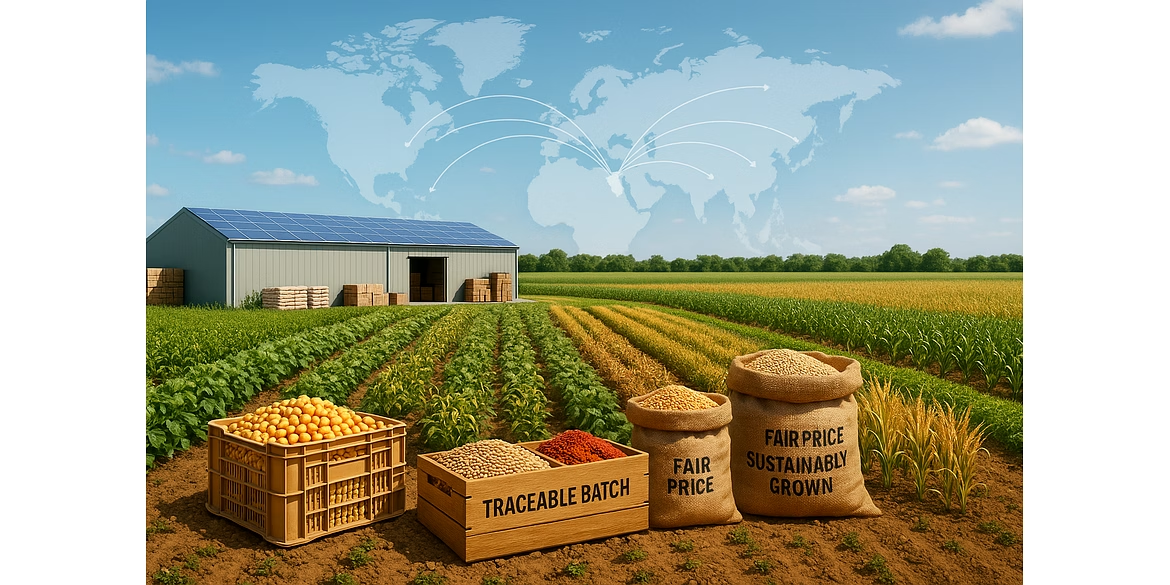
Global buyers today want more than just competitive prices—they want responsible sourcing, transparent supply chains, and partners who prioritize the welfare of farmers, the environment, and consumers. As regulations tighten and conscious consumers demand cleaner, more ethical products, sustainable sourcing is no longer a niche concept. It has become a global requirement for agri-importers and food brands.
At PAN International, sustainability, ethics, and farmer empowerment form the foundation of our export model. This approach not only delivers superior-quality agri-products—from grains, pulses, spices, and oil seeds to fresh produce—but also creates long-term value for our B2B partners worldwide. This guide explains what ethical and sustainable sourcing really means in the global agri supply chain and how PAN International puts these principles into practice.
1. What Ethical & Sustainable Sourcing Means for the Global Agri Supply Chain
Ethical sourcing goes beyond simple procurement. It focuses on how products are grown, harvested, processed, and traded across the entire supply chain. For importers, choosing ethically sourced agri-products from India helps protect brand reputation, manage compliance risk, and support long-term supply stability.
Ethical and sustainable sourcing at PAN International ensures:
✔ Fair treatment, fair pricing & dignity for farmers
Producers are compensated responsibly and supported with technical guidance, helping them move away from exploitative middlemen and towards stable, long-term partnerships.
✔ Environmentally responsible farming
We promote minimized chemical usage, soil health management, and water conservation so that crops are grown in harmony with local ecosystems.
✔ Clean, traceable, safe food products for importers
From spices and grains to oil seeds and fresh produce, every product is backed by testing and documentation that support safe, compliant imports.
✔ Supply chain transparency
Buyers know the origin, journey, and quality profile of every batch they receive through traceability and documentation.
✔ Long-term stability & reduced market volatility
Sustainable farming practices support consistent yields and predictable supply, reducing disruptions in global sourcing plans. This responsible sourcing philosophy drives every product at PAN International and underpins our long-term ethical agri-export partnerships.
2. PAN International’s Sustainable Farming Framework
Our sustainability commitment begins at the farm. PAN International collaborates with farmers and Farmer Producer Organisations (FPOs) across India to ensure that every crop is grown responsibly and with export-quality outcomes in mind.
✔ Soil Health Protection
We encourage practices such as:
• Minimal tilling to prevent soil erosion
• Organic inputs wherever feasible
• Balanced fertilization based on soil testing
• Crop rotation to enrich soil and manage pests naturally
✔ Responsible Pesticide Use
PAN International promotes:
• Integrated Pest Management (IPM)
• Safer pesticide alternatives and correct dosages
• Strict adherence to global MRL (Maximum Residue Limit) guidelines
This ensures that the final product is clean, safe, and compliant for import into regulated markets.
✔ Training & Capacity Building
Our agronomists conduct regular training sessions on:
• Post-harvest hygiene
• Sustainable crop practices
• Scientific storage and handling at farm and collection centers
This empowerment leads to consistent, export-quality output across seasons and crop types.
✔ Support for Rural Communities
PAN International strengthens rural communities through:
• Fair pricing and predictable procurement
• Access to market information and quality feedback
• Long-term procurement partnerships
For us, sustainability means people-first, planet-first progress that benefits both farmers and global buyers.
3. Traceability: The Backbone of Ethical Exporting
Modern buyers and regulators expect full visibility into where their food comes from and how it is handled. Traceability is therefore a cornerstone of ethical and sustainable exporting from India.
PAN International ensures farm-to-export traceability through a structured, technology-enabled system:
✔ Batch Coding at Procurement
Each lot is assigned a batch code that includes origin details, harvest date, farmer or FPO information, and product variety. This is the starting point of our traceable agri-export model.
✔ Digital Tracking Through Grading & Packing
As the product moves through grading, cleaning, and packing, each stage is documented and monitored to maintain full traceability.
✔ Pre-Shipment Testing Linked to Batch Codes
Laboratory reports—for MRL, moisture, purity, and microbiological parameters—are mapped to specific batch codes. These test results are shared transparently with importers.
✔ Traceability Labels on Export Packaging
Export cartons and bulk bags carry traceability information so that importers and retailers can quickly verify origin details. This builds buyer confidence and protects food safety in global traceable sourcing programs.
4. Ethical Processing & Quality Assurance Systems
Sustainability is not complete without ethical processing and robust quality control. PAN International ensures that all grains, pulses, spices, oil seeds, and fresh produce are processed in a way that maintains safety, consistency, and integrity.
✔ Multi-Step Cleaning & Sorting
Products pass through mechanized cleaning systems, gravity separators, and color sorters, followed by manual grading where required, to remove impurities and ensure uniform quality.
✔ Scientific Storage & Moisture Control
Warehouses are designed to protect commodities from moisture, pest attack, and contamination. Moisture levels are monitored to keep crops safe, stable, and suitable for export.
✔ Microbial, Chemical & Residue Testing
Accredited laboratories conduct tests for microbial load, pesticide residues, heavy metals, and other safety parameters as required by destination markets.
✔ Hygienic Handling & Food-Grade Packing
Handling areas are kept hygienic and equipped with food-grade materials to prevent contamination at every stage. Combined, these ethical processing standards translate into higher quality and lower risk for global importers.
5. Environmental Sustainability Across the Supply Chain
PAN International actively reduces environmental impact at farm, processing, and logistics stages. This is crucial for buyers looking to lower the carbon footprint of their agri supply chains.
✔ Water-Efficient Farming Practices
We promote drip irrigation, micro-irrigation, and low-water crops wherever suitable, conserving scarce water resources in farming communities.
✔ Waste Reduction in Processing Units
Strict sorting and storage controls minimize food waste. By-products are often channeled into animal feed or other value-added uses instead of being discarded.
✔ Eco-Friendly Packaging Options
We offer jute sacks, recyclable materials, and minimal-plastic solutions for buyers who want to reduce packaging impact while sourcing from India.
✔ Energy-Efficient Cold Chain & Logistics
Energy-efficient equipment and route-optimized logistics help reduce the carbon footprint associated with cooling, storage, and international transport.
Through these measures, PAN International contributes to a more sustainable global agri-ecosystem while helping importers meet their own ESG and climate goals.
6. Why Sustainable Exporters Create More Reliable Partnerships
Working with a sustainability-focused exporter like PAN International delivers long-term strategic value for importers and brands.
✔ Consistent quality every season—healthy soil and responsible practices lead to healthier crops and stable outputs.
✔ Lower risk of rejections at destination ports—thanks to compliance with MRL, food safety, and hygiene standards.
✔ Stronger brand reputation—consumers increasingly prefer ethically sourced, clean-label products.
✔ Reduced global supply chain disruptions—sustainable systems support resilience during market or climate shocks.
✔ Trust-based, long-term partnerships—ethical practices build predictable sourcing relationships and collaborative growth.
In short, sustainable exporters are better positioned to support complex, multi-market sourcing strategies for retailers, manufacturers, and distributors.
7. PAN International: Your Ethical & Sustainable Export Partner
PAN International stands for ethical, transparent, and sustainability-driven agri-exports from India. Our goal is to be more than a supplier—we aim to be your long-term partner in building responsible, resilient food supply chains.
✔ Integrity & Transparency
We uphold fair, honest, and responsible business practices, keeping buyers informed at every step of the sourcing process.
✔ Quality First
Advanced quality checks, expert supervision, and modern processing systems ensure that every shipment meets agreed specifications.
✔ Sustainability
We empower farmers, protect the environment, and promote clean agriculture practices across crops and regions.
✔ Customer Commitment
PAN International offers timely delivery, consistent quality, flexible solutions, and dedicated B2B support for importers, brands, and distributors.
We don’t just export agricultural products—we export trust, responsibility, and reliability in every container.
Conclusion: Building a Sustainable Future Together
The world is moving decisively toward responsible sourcing, and PAN International is proud to be at the forefront of this transformation in Indian agri-exports. By choosing a partner who prioritizes ethical farming, traceability, and environmental stewardship, importers strengthen their own brands while supporting farming communities.
With PAN International, buyers gain access to transparent supply chains, ethical farming networks, traceable and safe products, reliable logistics, and a partner invested in long-term progress. Together, we can build a global agricultural ecosystem that benefits farmers, buyers, and the planet alike.
